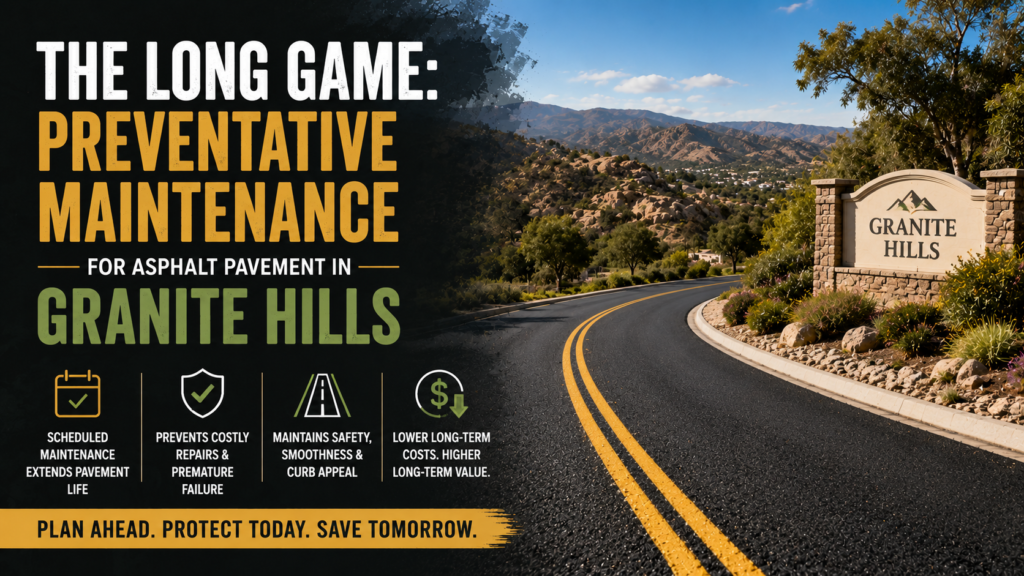
Granite Hills offers a wonderful quality of life with its established neighborhoods and scenic views. For homeowners and business owners here, asphalt pavement is a significant investment. But like any investment, it requires ongoing care to retain its value. Partnering with an experienced Asphalt Contractor Granite Hills trusts is the first step, but understanding the “why” behind maintenance empowers property owners to protect their pavement for decades.
The Natural Aging Process of Asphalt
Asphalt does not last forever. From the moment it is installed, it begins to age through a process called oxidation. The sun’s ultraviolet (UV) radiation breaks the carbon bonds in the asphalt binder (bitumen). As these bonds break, the binder becomes stiffer and more brittle. The pavement changes from a deep, rich black to a faded gray.
Oxidation is inevitable, but it can be slowed. The rate of oxidation depends on three factors: the quality of the original mix, the amount of air voids in the pavement, and the level of UV exposure. Granite Hills, with its sunny climate and higher elevation, accelerates oxidation compared to coastal areas.
Sealcoating: The UV Shield
Sealcoating is the single most effective preventative measure for asphalt. It is a liquid coating (typically coal tar emulsion or asphalt emulsion) applied to the surface. Sealcoating does not “strengthen” the pavement, but it provides a sacrificial layer that absorbs UV radiation and protects the underlying binder.
Many people ask, “How often should I sealcoat?” For a typical Granite Hills driveway, every 2 to 3 years is ideal. Signs that sealcoating is needed include a faded gray color, surface porosity (tiny holes), and the beginning of raveling (loose stones). Sealcoating should not be applied to a new driveway for at least 90 days to allow the asphalt to fully cure and for volatile solvents to evaporate.
Crack Filling: The First Line of Defense
A crack in asphalt is an open invitation to water. Water enters the crack, flows down to the base layer, and erodes the support structure. Once the base is compromised, the asphalt above it cracks further, in a self-reinforcing cycle that leads to potholes.
Crack filling is a simple but precise process. The crack is cleaned of debris and vegetation (often using a wire wheel or compressed air). A hot rubberized crack filler is then applied, which bonds to the crack walls and remains flexible. Flexible filler expands and contracts with temperature changes, unlike rigid patching materials that crack again within months.
Any crack wider than 1/8 inch should be filled immediately. Cracks smaller than that are typically cosmetic and can be covered by sealcoating.
Patching vs. Overlay: Knowing the Difference
When asphalt fails in a localized area such as a pothole or an alligator-cracked section property owners have two options: patching or overlay.
- Patching: The damaged area is cut out in a square or rectangle (using a saw-cut to create clean edges). The old material is removed, the base is repaired, and new asphalt is installed. Patching is best for isolated failures covering less than 25% of the total pavement area.
- Overlay: A new layer of asphalt (1.5-2 inches thick) is placed over the entire existing pavement. Overlays correct surface irregularities, restore skid resistance, and extend the pavement’s life by 10-15 years. Overlays cannot fix deep structural failures if the base is compromised, an overlay will fail quickly.
Pothole Repair: More Than Just Filling a Hole
Potholes are the most visible and dangerous form of asphalt failure. They form when water penetrates a crack, weakens the base, and traffic breaks the unsupported asphalt into pieces.
Proper pothole repair is not simply dumping cold patch into the hole. That is a temporary fix that lasts weeks. Permanent repair requires:
- Saw-cutting a neat rectangle around the pothole.
- Removing all damaged asphalt and soft base material.
- Applying a tack coat (glue) to the vertical edges.
- Placing and compacting hot mix asphalt in lifts.
- Sealing the edges.
This “cut and patch” method bonds the new asphalt to the old, creating a seamless repair that lasts for years.
The Role of Vegetation
Granite Hills properties often feature mature landscaping. While beautiful, trees and shrubs can damage asphalt. Tree roots seek moisture and will grow toward the water that collects beneath pavement cracks. Roots can lift pavement by several inches, creating trip hazards and drainage problems.
Prevention is easier than cure. When paving near existing trees, install root barriers (vertical sheets of plastic or metal) along the pavement edge. If roots have already caused damage, the affected section must be removed, the roots cut back, a barrier installed, and new pavement placed.
Weeds and grass growing through cracks are also problematic. Their roots widen cracks over time. Herbicide application followed by crack filling is the standard solution.
Striping and Marking for Parking Lots
For commercial properties in Granite Hills, parking lot striping is both a legal requirement and a courtesy to customers. Faded lines reduce parking capacity, confuse drivers, and create liability risks (people parking in fire lanes or handicap spaces).
Thermoplastic striping (a hot-applied plastic that melts onto the asphalt) lasts 5-7 years and is highly reflective. Paint striping lasts 1-2 years and is cheaper but requires more frequent reapplication. Reflective glass beads added to either material improve nighttime visibility.
Infrared Asphalt Repair
One innovative maintenance technique is infrared repair. For localized failures like potholes or utility cuts, infrared heaters soften the existing asphalt without removing it. The softened asphalt is raked, new material is added, and the area is compacted. The result is a seamless repair without visible joints.
Infrared repair is ideal for “spot” repairs in high-traffic areas because it creates a monolithic surface that is just as strong as the surrounding pavement. It is not suitable for large areas or for failures caused by base problems.
Winter Damage (Yes, Even in San Diego)
Granite Hills rarely freezes, but frost heave can still occur on cold winter mornings. When water in the base layer freezes, it expands by 9%. This expansion lifts the pavement. When it thaws, the pavement settles but not always back to its original position. Repeated freeze-thaw cycles cause cracking.
The solution is ensuring that the base layer is well-drained. If water cannot accumulate, it cannot freeze and heave. This is one reason why proper base preparation and drainage are emphasized so heavily in asphalt construction.
A Maintenance Checklist for Granite Hills Homeowners
For a typical residential driveway in Granite Hills, follow this annual maintenance schedule:
- Spring: Inspect for winter damage. Fill any new cracks. Clean gutters and downspouts that discharge onto the driveway.
- Summer: Apply sealcoating if the pavement looks gray or porous. Repair any potholes before the rainy season.
- Fall: Remove leaves and debris. Leaves that decompose on asphalt create an acidic environment that degrades the binder.
- Winter: After rains, check for ponding water. Note low spots for future repair.
The 20-Year Pavement Plan
Think of asphalt maintenance as a 20-year plan. Years 1-5: minimal maintenance (crack filling, sealcoating). Years 6-10: more frequent sealcoating, possible infrared repairs. Years 11-15: consider an overlay if the surface is worn but the base is sound. Years 16-20: plan for full replacement or major rehabilitation.
By understanding the science of asphalt deterioration and the value of proactive maintenance, Granite Hills property owners can maximize their investment and enjoy smooth, safe pavement for decades.